TL;DR: Sheer curtains hide you only when outside is brighter than inside, so at night, with your lights on, neighbours can see in.
The fix is a second, opaque night curtain on its own track, plus smarter lamp placement – not a thicker sheer.
Many of our customers love their sheer curtains in the afternoon, then get a shock one evening when they step outside the flat, look back, and see their whole living room glowing like a stage. If your HDB block or condo faces another block across a carpark, this is not your imagination. Sheers work beautifully in daylight and much less well after dark, and the reason is simple physics, not poor fabric. Here is why it happens and how we fix it for homes across Singapore.
Why can neighbours see through sheer curtains at night?
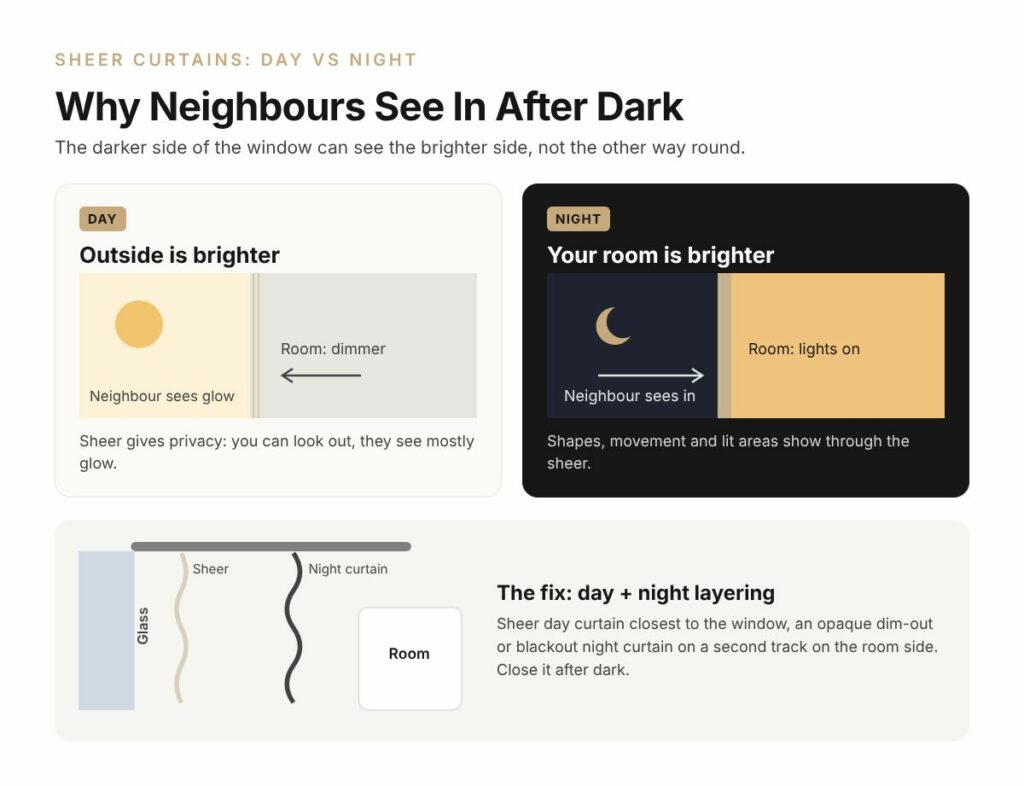
Neighbours can see in at night because your room is now the brighter side of the window. A sheer is a lightly woven, semi-transparent curtain; a little light passes through its gaps and some bounces off its surface. In the day, the sunlit outside floods the outer face of the fabric, so a neighbour sees mostly glow, while you, sitting in the dimmer room, can still look out. After sunset the ratio flips. Explaining one-way glass, the University of Illinois physics Q&A service notes that “the people in the dark side can see those on the bright side but not vice-versa” (University of Illinois Physics, Ask the Van). Your sheer behaves the same way.
This matters in Singapore because so many of us live close to our neighbours. According to the Department of Statistics Singapore (SingStat), 77.2% of resident households lived in HDB dwellings in 2025, with another 17.9% in condominiums and other apartments. Facing blocks, common corridors and low floors over a void deck all make night privacy a real daily concern.
Does fabric weight, weave or colour help?
They help a little, but no sheer fully stops the view at night. A heavier, tighter weave has smaller openings, so less of your room shows through. Voile curtains are fine, smooth and very open, which makes them airy by day and the most see-through after dark. Linen-look sheers have a thicker, slubbed yarn and irregular texture that breaks up shapes better, so silhouettes look softer.
Colour changes the effect too. White and ivory sheers reflect and scatter your indoor light, so they glow brightly and frame whatever is behind them. Grey, taupe and darker sheers absorb more light, so the curtain looks dimmer from outside and inside detail is harder to read. The trade-off is that darker sheers also look heavier by day. Fullness, meaning how much extra fabric is gathered across the track, also counts: more folds means more overlapping layers, which reduces see-through. Our sheer curtains Singapore page shows the voile, linen-blend and textured polyester options we carry.
What is day and night curtain layering?
Day and night layering means hanging two curtains on separate tracks: sheer day curtains closest to the window and an opaque night curtain on the room side. By day you draw only the sheer for soft light and privacy. At night you close the second layer and the problem disappears, because light from your room no longer reaches the glass. The night layer can be a dim-out fabric that softens the room, or full blackout curtains with a coated lining for bedrooms.
Plan this before your carpentry and false ceiling are finished. A double ceiling track needs enough width in the curtain pocket or pelmet, and both layers should overlap the window frame at the sides so light does not leak around the edges. We explain the hardware differences in our guide to curtain track types, and if you prefer a blind as the night layer, see layering curtains and blinds.
Sheer vs dim-out vs blackout: which night layer?
For living rooms, dim-out is usually enough; for bedrooms facing street lights or another block, choose blackout. The table compares typical behaviour; exact performance depends on the specific fabric, so ask us for samples.
| Layer | Day privacy | Night privacy (lights on) | Light control | Heat from sun |
|---|---|---|---|---|
| Sheer / voile | Good | Poor – shapes and lit rooms visible | Filters and softens | Slight reduction |
| Dim-out night curtain | Full | Good – no clear view in | Most light blocked, some glow | Moderate reduction |
| Blackout night curtain | Full | Full | Near-total block when well fitted | Best of the three |
If you go for blackout curtains, the lining and side returns matter as much as the fabric; our article on blackout curtain linings and light leaks covers this.
How should you place lights at night?
Keep the brightest lights away from the window and avoid standing between a lamp and the curtain. A floor lamp beside the window lights the fabric from behind and turns your sheer into a screen, while a person walking past a lamp throws a sharp shadow onto it. Use downlights or lamps on the inner wall, choose warmer, dimmer settings in the evening, and close the night layer before switching on the TV, whose glow is surprisingly visible from across the carpark.
Our tip: one evening, switch on your usual lights, step outside the flat and look back at your windows. A few minutes there shows you exactly which rooms need a night layer, before you spend on new fabric.
For living room curtains in particular, we usually suggest a soft sheer for daytime light and a dim-out night curtain in a matching tone, so the room still looks calm when both are drawn. You can browse ideas on our living room curtains page.
Ready for Private Evenings at Home?
Tell us which windows face another block and we will suggest a sheer and night-curtain pairing for each room. Contact our team to arrange measurement and see fabric samples against your own windows before you choose new sheer curtains.
Frequently Asked Questions
Can people see through sheer curtains at night?
Yes, when your lights are on and it is dark outside. Shapes, movement and lit areas are visible, especially through white voile curtains.
Do grey sheer curtains give more privacy than white?
Slightly. Darker sheers glow less, so detail is harder to see, but they still do not give full night privacy on their own.
What are night curtains?
Night curtains are the opaque layer, usually dim-out or blackout, hung on a second track behind sheer day curtains and closed after dark.
Do I need blackout curtains in the living room?
Usually not. Dim-out night curtains give full privacy in living rooms while keeping a softer look; blackout suits bedrooms and media rooms.
Can I add a night curtain to an existing single track?
Often yes, by adding a second track if the ceiling or pelmet space allows. We check this during measurement.