TL;DR: Blackout curtains are only as dark as their lining and their installation, so choose a 3-pass or separate blackout lining and add a white thermal backing for west-facing rooms.
Then mount the track wide and high, with returns at the sides and overlap in the centre, so light has nowhere left to leak.
Most people buy blackout curtains expecting a cave, then wake at 7am to a bright halo around the window. The fabric is rarely the problem. What decides how dark a room gets is how the lining is built and how the curtain is hung, and those two details are hardly ever explained at the point of sale. We have already covered fabric weave and GSM separately, so this guide focuses on what sits behind the face fabric and what happens at the edges. If you are shopping for blackout curtains Singapore homes can actually sleep behind, start here.
What Are the Different Types of Blackout Lining?
There are three main ways to make a curtain block light: a triple-weave fabric, a coated fabric, or a separate blackout lining sewn or hooked behind the face fabric. Triple-weave fabrics have a dark yarn woven into the middle layer, so they drape softly and feel like ordinary curtain fabric. Coated fabrics have foam layers applied to the back, and the number of passes matters. A 3-pass coating sandwiches a black layer between two white ones, so light is stopped in the middle and the white face toward the window reflects heat. A 2-pass coating has fewer layers and can show pinholes when you hold it up to a lamp. A separate blackout lining lets you pick any face fabric you like, including linen or velvet, and doubles the layers for extra insulation.
| Construction | Darkness | Drape and feel | Care in humidity | Best for |
|---|---|---|---|---|
| Triple-weave | High, lighter colours may glow slightly | Soft, natural | Often washable on a gentle cold cycle | Living rooms, guest rooms |
| 2-pass coated | Good, may show pinholes | Stiffer | Coating can crack with hot washing | Budget dim-out |
| 3-pass coated | Near-total | Stiffer, structured folds | Cool, gentle wash only | Bedrooms, shift workers |
| Separate blackout lining | Near-total | Depends on face fabric | Lining can be cleaned separately if detachable | Designer fabrics, west-facing rooms |
What Does “100% Blackout” Actually Mean?
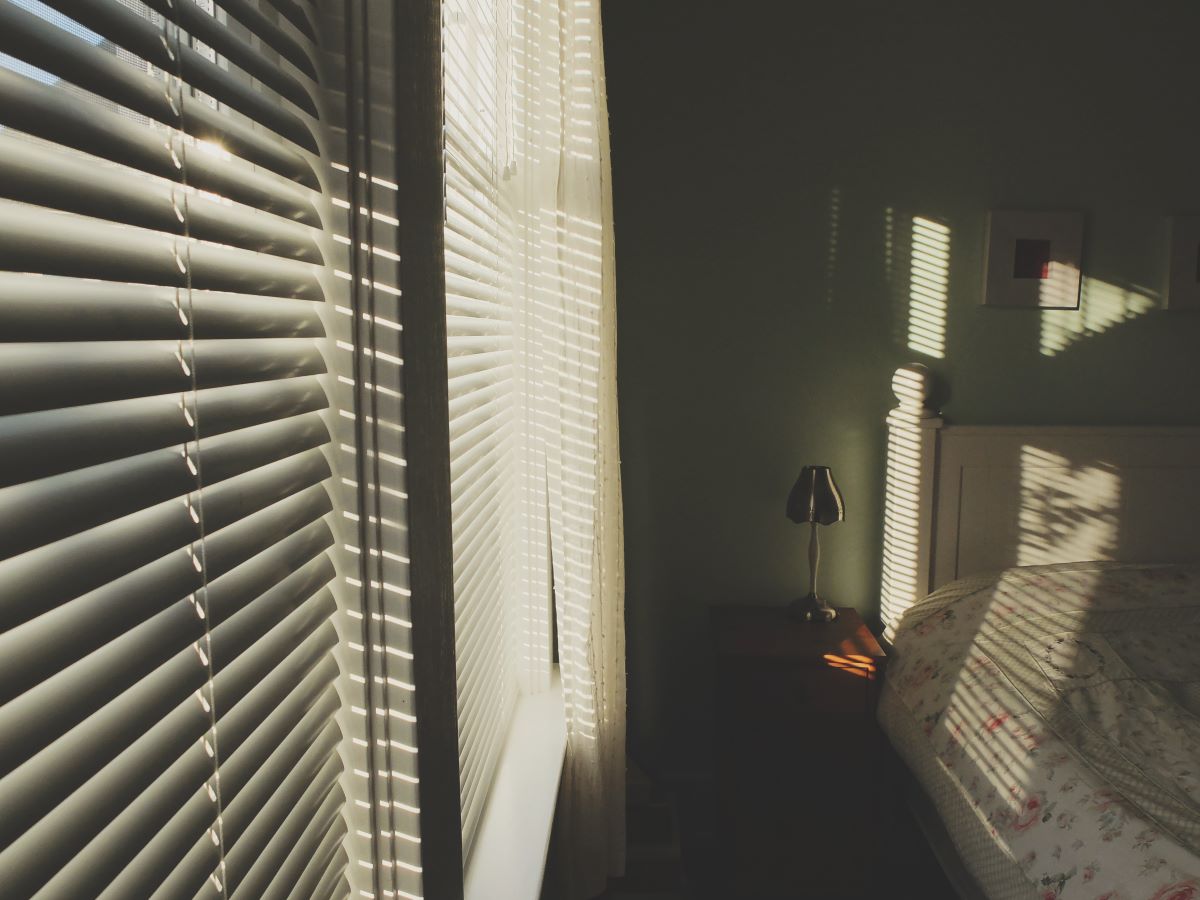
A blackout percentage describes how much light passes through the fabric itself, not how dark your room will be. A sample can genuinely block every photon in a lab and still leave the bedroom bright, because light gaps at the top, sides and centre do the damage. “Dim-out” fabrics block most light but leave a visible glow, which suits a living room but rarely satisfies a light sleeper. There is also the stitching to consider: every needle hole through a coated blackout lining lets a pinprick of light through, so ask whether seams and hems are sewn in a way that keeps stitch lines off the coated face.
Why darkness matters for blackout curtains for bedroom windows
The darker the room, the better for sleep. Researchers at Northwestern University found that a single night of sleeping with moderate room light impaired glucose and cardiovascular regulation, and the study’s senior author was blunt about it: “It’s important for people to avoid or minimize the amount of light exposure during sleep.” – Dr Phyllis Zee, Chief of Sleep Medicine, Northwestern University Feinberg School of Medicine (ScienceDaily). That is why blackout curtains for bedroom use deserve a 3-pass or separate lining rather than a cheap dim-out.
Do Thermal Curtains Help in a West-Facing HDB Flat?
Yes, they cut a noticeable share of the afternoon heat, though they cannot replace air-conditioning. According to the US Department of Energy, cited by Consumer Reports, medium-coloured draperies with white plastic backings can reduce heat gain by 33%. That white backing is exactly what a good 3-pass coating or thermal lining provides. In a west-facing HDB bedroom, where sun hits the glass from mid-afternoon, drawing thermal curtains before the sun swings round keeps the room noticeably cooler by bedtime. Most blackout linings give some of this benefit, while dedicated thermal curtains add a denser insulating layer. Choose a white or light-coloured backing facing the window, and avoid dark linings that absorb heat and radiate it back into the room.
Why Does Light Still Leak Around Blackout Curtains?
Light leaks because of installation, not fabric, and it escapes from four places. The top gap appears when the track sits on the wall just above the frame, so light spills up and over; a ceiling-mounted track or a pelmet closes it. Side light gaps appear when the track stops at the window edge; extending it well past the frame on both sides, and adding returns where the curtain wraps back to the wall, seals the edges. The centre gap appears when two panels simply meet; overlap arms let them cross. The bottom gap appears when the hem stops short; finishing just above the floor solves it. Our guide to curtain track types explains which tracks support ceiling mounting and overlap.
How Do You Care for Blackout Curtains Singapore Humidity Can Damage?
Wash gently, dry completely and keep air moving. The Meteorological Service Singapore puts mean annual relative humidity at around 82%, and a heavy blackout lining pressed against cool glass in an air-conditioned room is an easy place for mould to start. Vacuum curtains monthly, open them during the day so the back can breathe, and always follow the care label. Coated linings should never go into hot water, the dryer or under an iron, because heat cracks the coating and creates new pinholes. A detachable blackout lining is the easiest to care for, since you can clean the face fabric and lining separately and rehang them bone-dry.
Ready for a Darker, Cooler Bedroom?
Browse our custom curtains and tell us which way your windows face. Contact our team and we will help you choose the right lining and plan a track layout that leaves no light gaps around your blackout curtains.
Frequently Asked Questions
What are the best blackout curtains for a bedroom?
A 3-pass or separate blackout lining on a ceiling-mounted track with returns and centre overlap. The fabric can be fully blackout, but the room only goes dark when every gap is closed.
Is a 3-pass blackout lining better than triple-weave?
For pure darkness, usually yes. Triple-weave drapes more softly, while 3-pass blocks more light and reflects more heat.
Do thermal curtains reduce heat in Singapore?
Yes. A light-coloured backing reflects sun before it warms the room, which helps most on west-facing windows.
Can I machine-wash blackout curtains?
Check the label. Triple-weave often can on a gentle cold cycle; coated linings need cool, gentle cleaning and no tumble drying.
Why is there light at the top of my curtains?
The track sits below the ceiling. A ceiling track or pelmet stops light spilling over the top.